

A Google Business Profile gets you found. But it’s not something you own, and for a small business, that difference is the whole point.
We hear this from Triangle business owners with a sharp, well-run profile: it’s showing up in the map pack, pulling in calls and directions, and it cost nothing to set up. So the question lands honestly. If the profile is doing the work, is the website still worth it? Short answer: yes, and not for the reason most people think.
What a Google Business Profile actually does well
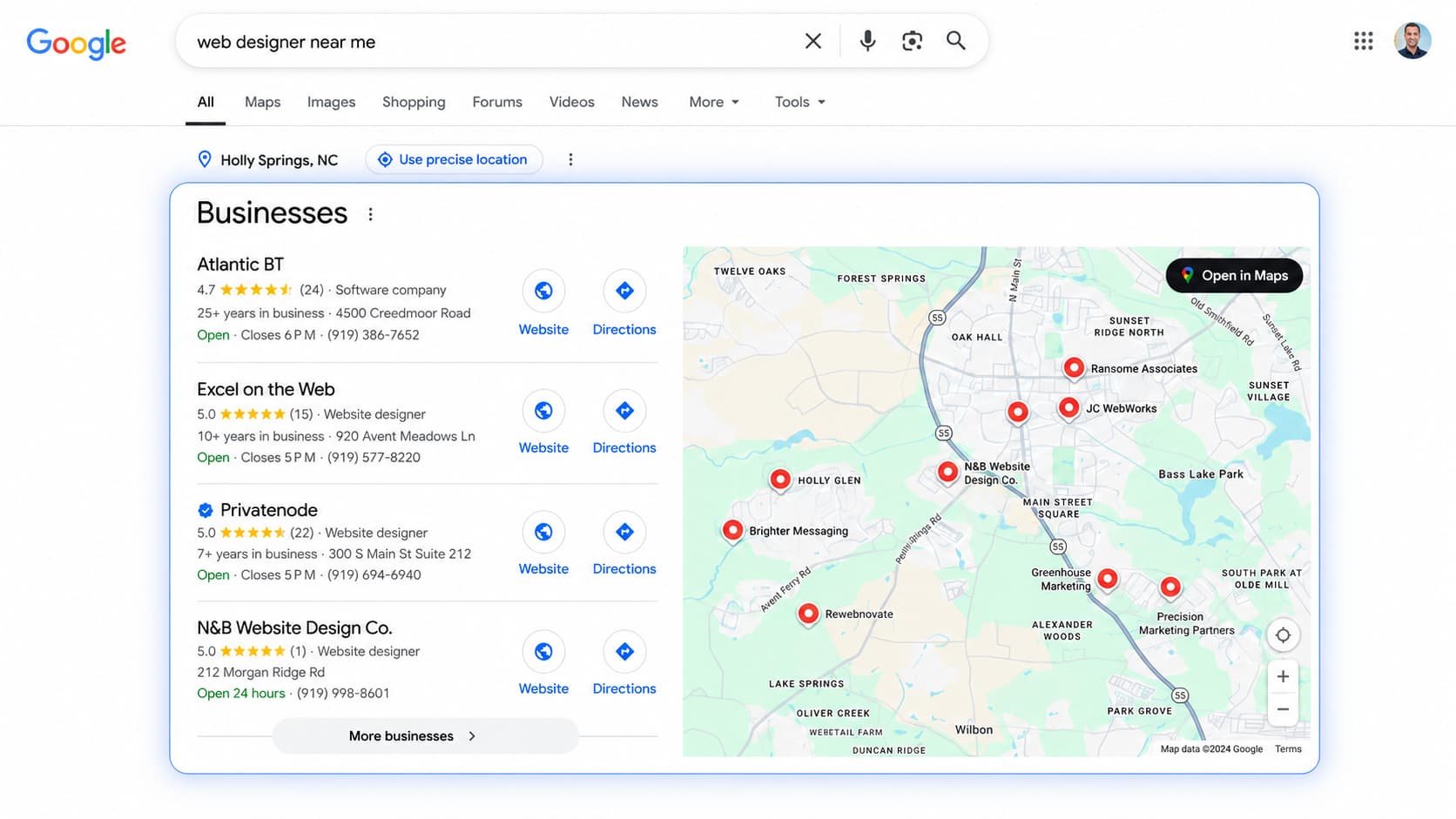
Credit where it’s due. For a local service business, a Google Business Profile is often the single fastest way to get found. It puts you in the map pack for “near me” searches, hands customers your phone number and directions, shows your hours and photos, and collects the reviews that convince the next caller you’re the real thing. It’s the fastest-moving local channel there is, and we tell clients to invest in it.
But look at what all of that has in common. It’s discovery. Getting found is the first step of the job, not the whole job.
The part you don’t own
Your profile lives on Google’s platform, under Google’s rules. The listing, the reviews, the ranking: none of it is actually yours.
Google can suspend a profile over a guideline issue you didn’t know you tripped. A keyword stuffed into the business name, an address that doesn’t match, a category edit that looks like manipulation. Getting it back means filing an appeal through Google’s process for suspended profiles, which Google says takes up to five business days, though the support forums are full of owners stuck in appeal loops far longer than that. While you wait, you’re invisible in the exact place you were getting found.
Your reviews make the point clearest. Years of five-star reviews are a genuine asset, but you can’t export them, move them, or take them with you. They belong to the listing, not to your business. The same goes for your ranking. Google can change how the map pack works tomorrow, and your position with it.
This is the same trap we wrote about in what de-platforming does to a business. When your presence lives on someone else’s platform, you’re one policy change away from starting over.
What a suspension actually looks like
This stops feeling abstract the moment it happens to you, so it’s worth walking through.
You search your own business name one morning and the listing is gone. No map pack, no reviews showing, no phone number, no directions. A customer who would have found you that day sees a competitor instead. You log in to a notice about a guideline you may not have realized you broke, and the only move available is the appeal: submit it, then wait.
During that wait, you can’t fix much. You can’t respond to a review, post an update, or correct the thing that got you flagged beyond that one appeal. The reviews you spent years earning are still on the listing, but they’re frozen and invisible to searchers. Your hours, your photos, your offers are all on hold. For a business that gets most of its calls from local search, that means the phone goes quiet until Google decides otherwise.
A website doesn’t have an off switch someone else controls. While the profile is stuck in review, your site is still up, still ranking for what it ranks for, still taking contact form submissions. It’s the difference between a bad week and a closed-for-business week.
Three things a Google Business Profile can’t do
The ownership problem is the deep one. But there’s a practical gap too. A profile structurally can’t do the parts of the job that actually win the customer.
It can’t explain what you do. A profile gives you a category and a 750-character business description, and Google’s own guidance tells you to keep even that focused on who you are rather than what you sell. That’s a business card. A company with more than one service, or any nuance to how it works with clients, needs room a profile doesn’t have.
It can’t capture leads on your terms. A profile hands off a phone call or a direction request and stops there. It can’t run the contact form that routes an inquiry to your inbox and the customer’s. On the sites we build, that’s a Gravity Forms setup with Gravity SMTP and Mailgun, so submissions actually arrive in both inboxes instead of silently failing. That’s the kind of reliability a profile was never built to provide.
It can’t rank for searches that aren’t “near me.” Someone typing “how much does a website cost in Apex” or “wordpress maintenance for a law firm” isn’t getting their answer from a map pack. Those searches go to web pages, and usually no profile competes for them. Every one of them is a customer your profile can’t reach.
“But can’t I just…”
Two fair pushbacks come up here, and both have real answers.
“Can’t I just add my website link to the profile?” You can, and you should. But the link field points to your website. It isn’t a substitute for having one. If it points at a thin one-pager or nothing at all, the click lands flat. The profile drives the visit; the site has to earn the customer once they arrive.
“Isn’t a simple one-page site enough?” Often, yes. A small, well-built site you own is a perfectly good starting point, and it beats holding out for a big site you never actually get built. The catch isn’t size, it’s whether it’s a real site you own. A free site-builder page you don’t truly control, or a thin page nobody maintains, isn’t the same thing as a small site done properly. Start small if that’s what the budget allows. Just start with something that’s actually yours and built to grow when you are.
The honest version: a profile plus a real website beats a profile plus a link to a thin page, every time. The website is where the depth lives, and depth is what ranks and what convinces a customer to hire you.
How they actually work together
This was never a question of website versus profile. It’s discovery versus conversion, and a small business needs both.
The profile is how a customer in Holly Springs or Apex finds you in the first place. The website is where they decide to hire you, and it’s the one piece of the whole setup you own outright: the domain, the pages, the leads, and the design. Lean only on the profile and you’ve built your entire presence on rented land. Lean only on the website and you’re hard to find locally. Put the two together and you’re found and you own what you’ve built.
Owning it also means someone has to keep it running. The domain, the backups, the hosting, the updates. That’s the part that quietly falls apart when no one’s accountable for it, and it’s what ongoing website care is for.
What to actually do with this
If you’ve got a profile and no website, you’re not in trouble, but you do have a gap. Here’s the order that works:
- Claim and fully optimize your Google Business Profile. It’s still your fastest path to getting found locally, so don’t neglect it.
- Put a real site behind it. Somewhere you own, that explains what you do, captures leads reliably, and can rank for the searches a map pack never will.
- Make sure someone’s actually maintaining it. A site nobody updates becomes its own problem.
Profile first if you’re starting from zero, because it’s quick and it works. Website close behind, because it’s the half of your presence you’ll still have on the worst day.
So keep the profile. Optimize it, feed it reviews, let it pull in local searches all day. Just don’t build the whole business on top of it. The profile is how people find you. The website is what you own, and owning it is the whole point.
If there’s a gap between the profile you’ve got and the site sitting behind it, now’s the time to close it. Here’s how we build websites that convert and that you actually own.

Leave a Reply