
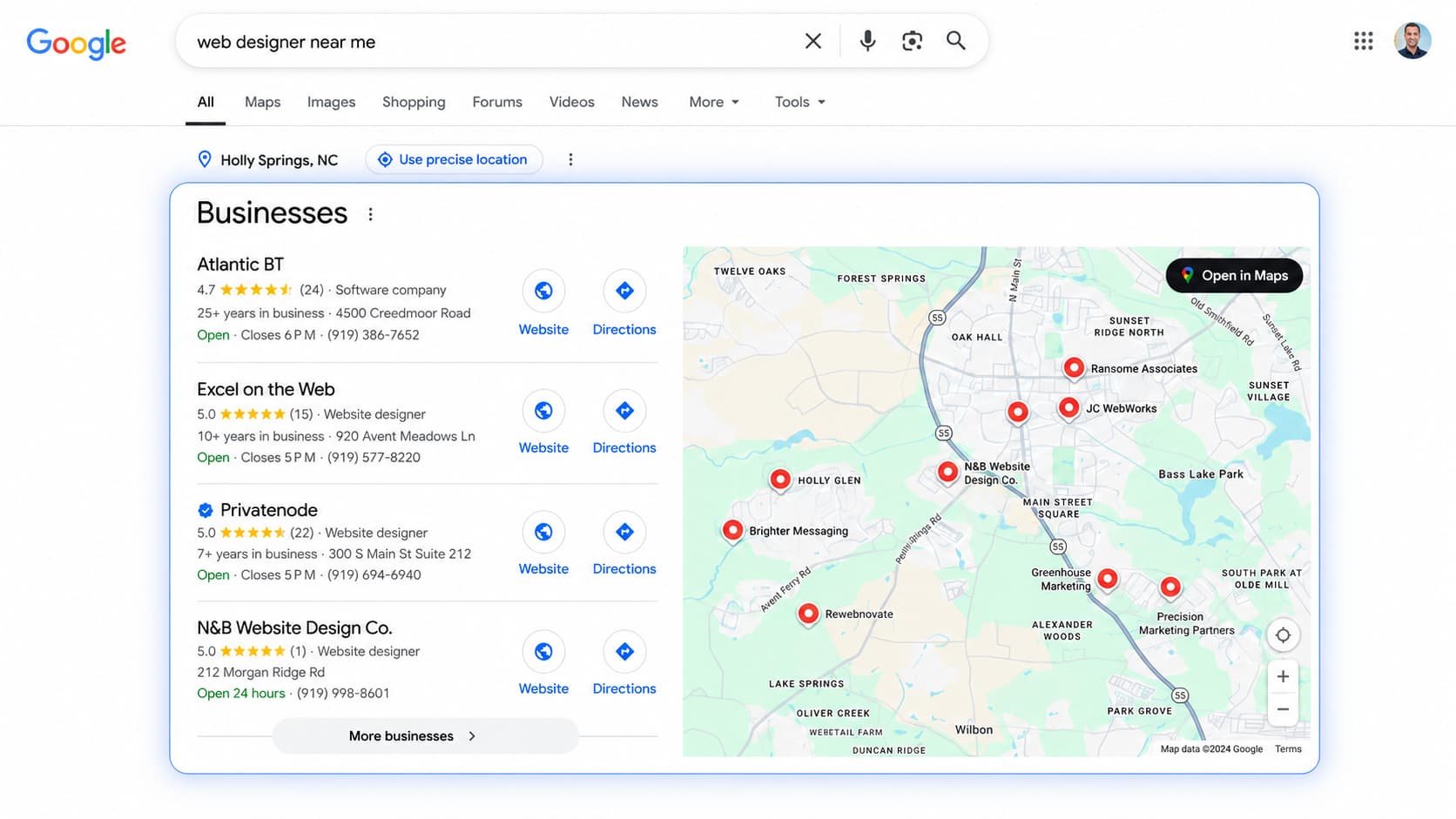
When someone searches “web designer near me” or “plumber in Durham,” the first thing they see is a small map with three businesses pinned under it. That block is the map pack, and for a local business it is the most valuable spot on the entire page. It sits above the regular blue links, it shows your reviews and phone number, and it is where most local customers decide who to call. If you are not in it, you are mostly invisible for the searches that bring in real work.
Getting into it is not random, and you cannot buy your way in. The pack runs on three signals, and a small business controls more of them than most owners think.
The Three Things Google Uses to Rank the Map Pack
Google ranks local results on relevance, distance, and prominence. That is Google’s own framing, straight from the Business Profile help docs, and it has stayed consistent for years.
Relevance is how well your business matches what the person searched. Distance is how close you are to the searcher or the place they named. Prominence is how well known and trusted your business looks, mostly through reviews, an active profile, and mentions across the web.
Distance you cannot change. The other two you can, and that is where the work is.
Why Distance Decides More Than You Want It To
Here is the part nobody likes: for a lot of searches, proximity carries a lot of weight. A searcher standing in one town usually sees businesses in that town, even if a stronger company sits fifteen minutes away.
We work with businesses across the Triangle, and we see this every week. Privatenode ranks in the Holly Springs map pack, our home town, but the packs in nearby Garner and Morrisville are filled with businesses physically based in those towns, sometimes with only a handful of reviews. Proximity is doing the heavy lifting there.
So be realistic about the towns nearby. Win the map pack where you are actually located, and for the surrounding towns, lean on your website and your service pages instead of expecting a pack slot you cannot reach. Chasing a pack in a town you have no address in is the fastest way to waste a marketing budget.
Fixing Relevance: Make Your Profile and Your Site Agree
Relevance starts with your Google Business Profile, and most profiles leave easy points on the table.
Set your primary category to exactly what you do, not something broad. A bakery should be “Bakery,” not “Restaurant.” Add every real service, fill in your hours, and write a description that names what you do and where. Then make sure your website says the same thing. If your profile calls you a web designer and your homepage talks about “digital solutions,” Google gets a weaker signal from the mismatch. The profile and the site backing it up need to tell one clear story.
One detail owners miss: your name, address, and phone number have to match everywhere, exactly. “Suite 200” on your site and “Ste 200” on an old directory listing counts as two different addresses to a machine. Clean those up.
Building Prominence: Reviews, Activity, and Citations
Prominence is the lever that moves the pack over weeks, and it is mostly reviews.
Reviews do double duty. They tell Google your business is real and trusted, and they tell the human searcher the same thing. You do not need hundreds of them to compete. What matters is a steady trickle coming in over time and a solid overall rating. The simplest system that works: ask every happy customer for a Google review right after the job, with a direct link, so it takes them thirty seconds.
Two more things feed prominence. Post to your profile regularly, because an active profile signals a live business, and a profile that has gone quiet for months slides. And get listed accurately on the directories that matter for your industry, with that same consistent name, address, and phone. This is ongoing work, and the businesses that keep the habit are the ones that hold the top of the pack.
Why the Map Pack Still Needs a Real Website Behind It
It is tempting to think a strong Google profile means you can skip a website. It does not, for one blunt reason: you do not own your Google profile, Google does. A suspension or a policy change can take it down overnight, and your relevance signals lean on a website that confirms who you are and what you do anyway.
The pack is what gets you seen, but your website is where the click actually lands. It is where the customer decides you are legitimate, and where the contact form sends you the lead. A website that backs up your profile, one that matches your listing and keeps your site fast and secure over time, is what turns map-pack visibility into calls. The two work as one system.
A business that is invisible in the map pack is usually losing to closer, more active competitors, and only one of those is out of your hands. If you want your Google Business Profile and your website working together so you show up locally and turn that visibility into real leads, let’s talk.


Leave a Reply